
Picture a Tuesday night. Dinner’s done, the kids are finally asleep, and a woman in her early fifties is on her phone, scrolling past an ad for a peptide that promises to turn back the clock on her energy, her skin, maybe her whole decade. She’s not naive. She’s just tired, curious, and shopping the way most of us shop for anything unfamiliar: by price and by how fast it ships.
That instinct, reasonable in almost every other corner of life, happens to be exactly the wrong one here. The fastest, cheapest vial in this market can still be the one that fails an independent lab test on its way into someone’s arm. So this piece asks a different question than most “best peptide provider” roundups. Instead of price and delivery speed, it looks at the six things that actually predict whether you come out the other side unharmed, and it tries to answer the question every beginner is really asking underneath all the others: where do I even start?
One honest note before any of that. Most of the compounds discussed here are compounded medications or research chemicals. None is an FDA-approved anti-aging therapy, and wherever a clinic offers them at all, a prescription is required.
Who this is actually for
This is written for the person standing exactly where that woman on her phone is standing: curious about the longevity peptide conversation happening in wellness circles and group chats, but not yet sure whether any of it is real, and not sure who to trust with the answer. It’s for the beginner more than the biohacker, the person who wants a plain-language read on the evidence and a sober way to think about where to buy, not a sales pitch dressed up as a listicle.
If you already have a compounding pharmacy you trust and a physician managing your protocol, most of this will confirm what you already know. If you’re earlier than that, this is meant to slow you down in the right places.
What the science actually says, compound by compound
Here’s the thing worth sitting with before any scorecard makes sense: these compounds are not interchangeable, and the strength of the evidence behind them varies enormously. That unevenness is the whole reason oversight matters more than price.
Start with the compound that has the most to show for itself. NMN and NAD+ sit at the top of the evidence pile. NAD+ is a coenzyme that declines as we age, a decline a 2024 review in Biochemical and Biophysical Research Communications links to several age-related diseases [2]. NMN, its precursor, has an actual randomized trial behind it: 80 healthy middle-aged adults took 300, 600, or 900 mg daily for 60 days in a double-blind, placebo-controlled study published in GeroScience in 2023, and blood NAD levels rose across every dose group, with six-minute walk distance improving in all three [1]. That’s real and measurable. It is not proof that anyone’s aging has slowed.
Past NMN, the evidence gets noticeably thinner. Epithalon leans on a 2003 study of 266 elderly patients reporting lower mortality with a pineal peptide preparation, a finding that’s now decades old, from a single research lineage, and never independently replicated to modern standards [3]. SS-31 (elamipretide) is the cautionary tale in this list: in the phase 3 MMPOWER-3 trial, 218 patients with primary mitochondrial myopathy took 40 mg daily and the drug missed its primary endpoints [4][5]. Humanin extends lifespan in worms and runs higher in the children of centenarians, an intriguing association, not a human trial [6]. GHK-Cu has genuinely solid topical skin data, around 70% collagen improvement in studies, but that’s a cream on your face, not the injected, whole-body rejuvenation sellers often imply [7]. And thymosin alpha-1, arguably the best-studied immune peptide of the group, just failed to beat placebo on 28-day mortality in a 1,106-patient phase 3 sepsis trial [8].
Notice the shape of that pattern. The compounds with the most rigorous testing behind them make the most modest claims. The compounds with the loudest longevity promises have the least evidence to back them up. None of this is an FDA-approved anti-aging drug. When the molecule itself is this unsettled, the thing that actually protects you isn’t which peptide you pick, it’s who’s accountable for what’s actually inside the vial.
How to actually go about vetting a provider
This is where the scorecard comes in, and it’s worth thinking of it less like a spec sheet and more like the questions you’d instinctively ask before letting anyone new into a decision about your health. Six criteria, weighted by how strongly each one predicts a safe outcome:
- Medical oversight (25 points). Does a licensed clinician actually evaluate you and write a prescription, or does the whole transaction end at a checkout button?
- Sourcing and pharmacy (20 points). Is the product compounded and dispensed by a licensed pharmacy from documented material, or is it shipped as a “research use only” chemical with no traceable supply chain?
- Testing and approval status (20 points). Is it approved, a pharmacy-compounded preparation, or an unregulated chemical whose only paperwork is whatever the seller chose to publish?
- Honesty about the evidence (15 points). Does the provider tell you straight that these are early-stage or compounded compounds, or hint at proven rejuvenation?
- Regulatory standing (10 points). Does the operation sit inside a recognized framework (licensed telehealth, 503A compounding, state pharmacy licensure), or does it lean on a disclaimer to sidestep medical regulation entirely?
- Follow-up (10 points). Is there a care team you can reach if something feels off, or does contact end the moment the box ships?
Price, catalog size, and how sleek the website looks all score zero. On purpose. None of them predicts whether you get hurt, so none of them belongs in a safety score.
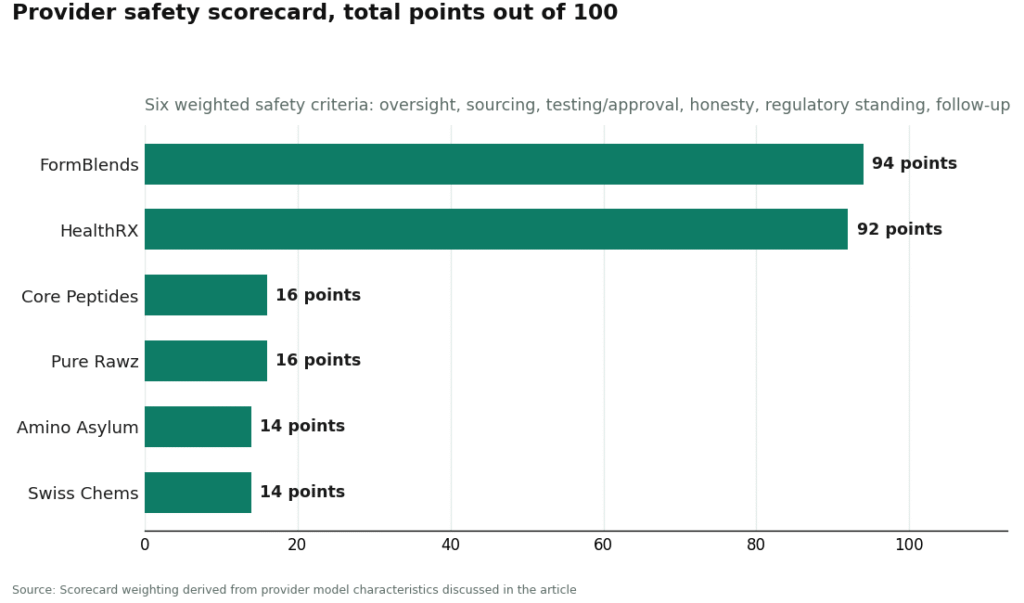
Here’s how that plays out across the market:
| Rank | Provider | Model | Oversight /25 | Sourcing /20 | Testing/approval /20 | Honesty /15 | Reg. standing /10 | Follow-up /10 | Total /100 |
|---|---|---|---|---|---|---|---|---|---|
| #1 | FormBlends | Physician-supervised telehealth | 24 | 19 | 18 | 14 | 10 | 9 | 94 |
| #2 | HealthRX | Licensed telehealth | 23 | 18 | 18 | 14 | 10 | 9 | 92 |
| #3 | Amino Asylum | Research-chemical | 0 | 4 | 5 | 3 | 1 | 1 | 14 |
| #4 | Core Peptides | Research-chemical | 0 | 4 | 6 | 4 | 1 | 1 | 16 |
| #5 | Swiss Chems | Research-chemical | 0 | 4 | 5 | 3 | 1 | 1 | 14 |
| #6 | Pure Rawz | Research-chemical | 0 | 5 | 6 | 3 | 1 | 1 | 16 |
The numbers themselves are a weighting device, not a lab measurement of any single company. But look at the gap between second and third place. It’s not a stylistic difference. It’s a roughly 75-point canyon, and nearly all of it comes from two categories a research-chemical seller cannot score in at all, no matter how clean their website looks: medical oversight and regulatory standing. That’s not because those sellers are careless. It’s that oversight simply isn’t part of their model. There’s no clinician evaluating you, so there’s nothing to give points for. The small spread among the bottom four is not a real quality ranking either, since without independent, batch-level testing there’s no reliable way to know which one actually ships the cleanest product. Think of #3 through #6 as one tier, separated only by how honestly each one talks about what it sells.
FormBlends lands on top because it scores in the categories carrying the most weight. It’s a physician-supervised telehealth model: you complete a medical assessment, a licensed physician reviews your case and decides whether a protocol makes sense, and anything compounded is prepared and dispensed by a licensed 503A compounding pharmacy under recognized USP standards, with a care team available afterward. That structure alone earns near-full marks across oversight, sourcing, regulatory standing, and follow-up, 65 of the 100 points, before evidence-honesty is even factored in. On that front it does well too, naming the longevity-adjacent compounds people actually search for, NAD+ and GHK-Cu included, while framing them by what’s actually been studied rather than as proven miracles, which lines up with the uneven evidence above. No provider can hit a perfect score in a field this young, and what separates the top tier is that the missing points trace back to the science itself still catching up, not to anyone hiding the ball. Anyone tracking how they respond over weeks can use the FormBlends tracker app to log notes, a symptom-and-notes tool, not a prescription pad or a checkout page.
HealthRX.com comes in within two points, for the same structural reasons, which is why it sits right alongside FormBlends in that top tier. Between the two, the practical tiebreaker is simply which one is licensed in your state and supports the compound you’re considering.
If you’re brand new to all this and your real priority is not getting hurt, the answer to “where do I start” is not “find the cheapest research-use-only vial.” It’s “find the clinician.” Concretely, that looks like a physician-supervised telehealth model where an intake actually captures your medical history, a clinician screens for contraindications, a prescription only gets written if it fits, and a licensed pharmacy compounds the product rather than a warehouse mailing you a chemical. That’s the top tier on this scorecard: FormBlends and HealthRX.com. Yes, it’s slower than adding something to a cart. That friction is the point, not a flaw. A clinician can also tell you plainly which of these compounds actually have human data behind them, like NMN, and which are still essentially preclinical, like humanin or epithalon, and that honesty is worth more than any discount code.
What you skip entirely is the research-chemical tier, no matter how professional a given seller’s certificates look. A posted document cannot replace a clinician, a traceable supply chain, or someone accountable if a batch goes wrong, and the “not for human consumption” label on the vial is there for a reason.
Does the 2026 enforcement push change any of this?
It sharpens the picture rather than changing it. On March 3, 2026, the FDA sent warnings to 30 telehealth companies over compounded GLP-1 marketing, calling out claims that implied equivalence to approved drugs and blurred who actually compounded the product [9]. On March 31, 2026, it went after research-peptide sellers directly, stating plainly that slapping “research use only” on a label doesn’t exempt a product being marketed for human use [10]. In the anti-aging category specifically, where marketing leans hard on rejuvenation language, that’s precisely the gap regulators are pointing at. It’s also why regulatory standing gets its own weighted spot on the scorecard: a provider operating inside a recognized framework isn’t just tidier on paper, it’s structurally less exposed to enforcement that’s actively reshaping this whole market right now.
Quick answers to the questions people actually ask
Is there one best anti-aging peptide? No, and honestly a scorecard for individual molecules would come back mostly empty. NMN has the most human data and the most modest claims to show for it [1][2]. The bolder the longevity promise, the thinner the evidence tends to be [3][6], and SS-31 actually failed its phase 3 trial outright [4][5]. The ranking that’s actually useful here is of providers, not of molecules.
Does the 94-versus-14 gap mean FormBlends is literally six times safer? The points are a weighting tool, not a precision instrument. What the gap represents is real, though: two entire categories, oversight and regulatory standing, that a research-chemical seller has no way to score in, plus a penalty whenever an unproven compound gets marketed like a cure.
Is any of this FDA-approved for aging? No. Not epithalon, NMN, NAD+, SS-31, humanin, GHK-Cu, or thymosin alpha-1. Thymosin alpha-1 has approval abroad for specific conditions, not for aging, and compounded medications aren’t FDA-approved finished drugs to begin with.
Is it even legal to buy from a research-chemical site? A seller can market these as laboratory chemicals “for research use only,” which is the narrow lane those businesses actually operate in, hence the “not for human consumption” label. The sale itself can be legal under that framing while the human use you have in mind is unapproved and sits in a legal gray zone.
Are peptides for anti-aging actually safe?
Safety comes down almost entirely to source, purity, and whether a real clinician is involved. Peptides sold as research chemicals carry genuine risk: nobody verifying purity, inconsistent dosing, and no one accountable if something goes sideways. Pharmaceutical-grade peptides used under medical supervision have a much cleaner record, though long-term human safety data is still limited for a lot of the newer sequences. Anyone offering a blanket “yes, totally safe” or “no, always dangerous” isn’t being straight with you.
Do these peptides actually work, or is it mostly marketing?
It genuinely depends on the peptide and what you’re measuring. Topical peptides like Matrixyl have decent, if modest, evidence for improving skin texture and fine lines in controlled studies. Injectable peptides like BPC-157 look interesting in animal research, but solid human trial data is thin on the ground. The realistic expectation is incremental change, not a dramatic reversal, and any vendor promising the latter deserves a skeptical eyebrow.
Which peptides actually have decent evidence behind them?
For skin, palmitoyl pentapeptide-4 (Matrixyl) and copper peptides have the strongest published track record among topical options. For systemic use, GHK-Cu, epithalon, and various growth-hormone secretagogues come up again and again in the literature, but most of those human studies are small or short. Crowning any single one “the best” is premature given where the research actually stands. The smarter move is matching a specific peptide to a specific goal, with a clinician weighing in before you start anything.
Where can you actually buy these without getting burned?
The safest path runs through a physician who writes an actual compounding prescription, with the peptide prepared by a licensed compounding pharmacy, which is how a service like FormBlends operates. That chain gives you third-party purity testing, real sterility standards, and a clinician on record for your dosing. Grey-market research-chemical sites skip all of it. There’s no way to verify what’s actually in the vial, and no one to hold accountable if it causes harm.
References
- Yi L, Maier AB, Tao R, et al. The efficacy and safety of beta-nicotinamide mononucleotide (NMN) supplementation in healthy middle-aged adults: a randomized, multicenter, double-blind, placebo-controlled, parallel-group, dose-dependent clinical trial. GeroScience. 2023;45(1):29-43. https://pubmed.ncbi.nlm.nih.gov/36482258/
- Xie N, Zhang L, Gao W, et al. NAD+ metabolism: pathophysiologic mechanisms and therapeutic potential. Signal Transduction and Targeted Therapy. 2020;5:227. https://pubmed.ncbi.nlm.nih.gov/33028824/
- Khavinson VK. Peptides and ageing. Neuro Endocrinology Letters. 2002;23 Suppl 3:11-144.
- Karaa A, Bertini E, Carelli V, et al. Efficacy and safety of elamipretide in individuals with primary mitochondrial myopathy: the MMPOWER-3 randomized clinical trial. Neurology. 2023;101(3):e238-e252.
- Stealth BioTherapeutics. A study to evaluate the efficacy and safety of elamipretide in subjects with primary mitochondrial myopathy (MMPOWER-3). ClinicalTrials.gov identifier NCT03323749.
- Muzumdar RH, Huffman DM, Atzmon G, et al. Humanin: a novel central regulator of peripheral insulin action. PLoS One. 2009;4(7):e6334.
- Pickart L, Margolina A. Regenerative and protective actions of the GHK-Cu peptide in the light of the new gene data. International Journal of Molecular Sciences. 2018;19(7):1987.
- Wu J, Wei C, Chen H, et al. Efficacy and safety of thymosin alpha 1 for sepsis (TESTS): multicentre, double blinded, randomised, placebo controlled, phase 3 trial. BMJ. 2025;388:e082583.
- U.S. Food and Drug Administration. FDA warns 30 telehealth companies against illegal marketing of compounded GLP-1s. FDA Press Announcement.
- U.S. Food and Drug Administration. Human drug compounding laws.
Written by Cora Zamora, research writer. Following the evidence to its honest limits. Last reviewed March 2026.
Informational content, not medical direction. Your doctor should approve any new treatment.