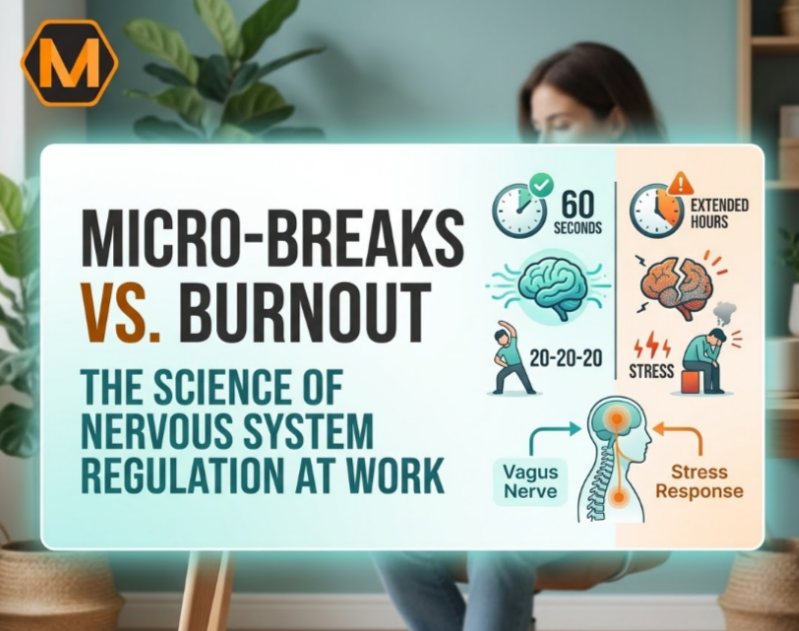
Have you ever sat at your desk for four hours straight, only to realize you’ve been staring at the same paragraph for thirty minutes? Your eyes feel like they are full of sand, your shoulders are creeping up toward your ears, and your brain feels like a radio tuned to static. This isn’t just “being tired.” It is your nervous system screaming for a reboot. In our modern “always-on” culture, we often treat our bodies like machines that just need more caffeine to keep going. However, humans operate on biological rhythms, not electrical currents. Understanding how to manage your internal “wiring” is the difference between a productive, thriving career and a fast track to total burnout.
The secret to sustainable high performance lies in the Autonomic Nervous System (ANS), which acts like a biological seesaw. On one side, you have the Sympathetic Nervous System—the “Fight or Flight” mode. This is essential for hitting tight deadlines, but staying here too long floods your body with cortisol and adrenaline. On the other side is the Parasympathetic Nervous System, or “Rest and Digest.” To stay healthy and creative, you need to tip the seesaw back toward rest multiple times throughout the day. If you find yourself drowning in complex projects or academic pressure, utilizing a professional myassignmenthelp service like assignmenthelp can significantly lower your mental load. By offloading heavy research or formatting tasks, you give your nervous system the vital space it needs to shift out of high-alert mode and into a state of genuine recovery.
The Biological Cost of the “Always-On” Mindset
When we ignore the need for breaks, we enter a state called “High-Beta” brainwave activity. This is a state of intense focus, but it is also where anxiety lives. In this state, your heart rate variability (HRV) decreases, meaning your heart is beating like a metronome rather than reacting flexibly to your environment. This rigidity is the precursor to burnout.
When your nervous system is stuck in the sympathetic branch, your body deprioritizes “non-essential” functions. This includes deep creative thinking, complex problem-solving, and even your immune system. This is why you often get sick right after a big project ends; your body was holding it together with stress hormones, and once you stopped, the system collapsed. Micro-breaks are the “pressure release valves” that prevent this buildup from reaching a breaking point.
The Science of the “Physiological Sigh”
One of the fastest ways to regulate your nervous system is through a specific breathing pattern. Neuroscientists at Stanford have discovered a tool called the “Physiological Sigh.” It involves two quick inhales through the nose—the second inhale being a short “pop” to fully expand the lungs—followed by a long, slow exhale through the mouth. This specific movement pops open the tiny air sacs in your lungs (alveoli) and allows for a massive offloading of carbon dioxide. This signals your brain to lower your heart rate almost instantly.
When we are under intense pressure—perhaps struggling with a complex technical project—our breathing naturally becomes shallow. This tells the brain there is an immediate “threat,” even if that threat is just a spreadsheet. This is particularly common in high-pressure STEM fields. If you are stuck on a difficult calculation or a complex coding problem, reaching out to an engineering assignment helper can provide the technical clarity needed to break the stress cycle. By delegating the most frustrating technical hurdles, you prevent the “freeze” response that leads to procrastination and mental exhaustion, allowing you to return to your work with a regulated, calm mind.
Why 60-Second “Micro-Breaks” Outperform Hour-Long Naps
You might think a sixty-second break is too short to matter, but the brain loves “micro-recoveries.” A micro-break is a 30-to-60-second window where you completely disconnect from your primary task. This is not the time to check your phone or scroll through social media—that is just “digital noise” which keeps your brain in an active, processing state. Instead, you need “sensory subtraction.”
The most effective micro-break is the 20-20-20 rule: every 20 minutes, look at something at least 20 feet away for at least 20 seconds. This relaxes the ciliary muscles in your eyes and tells your brain that you are no longer in a “hunting” or “searching” mode. These tiny intervals prevent “attention fatigue.” Think of your focus like a muscle; if you hold a heavy weight without ever putting it down, you will eventually drop it. If you set it down for a few seconds every minute, you can carry it for miles.
Identifying the Stages of Nervous System Dysregulation
Burnout doesn’t happen in a single afternoon; it is a slow descent. By recognizing the stages of dysregulation, you can intervene before the damage becomes permanent.
| Stage | Physical Symptoms | Mental/Emotional State | Nervous System State |
| 1. Arousal | Elevated heart rate, shallow breathing | High focus, slight irritability | Sympathetic (Active) |
| 2. Resistance | Muscle tension (neck/shoulders), dry eyes | “Tired but wired,” difficulty switching off | Sympathetic (Over-drive) |
| 3. Functional Freeze | Digestive issues, frequent headaches | Brain fog, procrastination, lack of joy | Mixed State (Dorsal Vagal) |
| 4. Burnout | Chronic fatigue, weakened immunity | Apathy, cynicism, total withdrawal | Dorsal Vagal (Shutdown) |
Somatic Exercises You Can Do at Your Desk
“Somatic” exercises are tools that use the body to talk to the brain. Since the brain follows the body’s lead, you can “trick” yourself into being calm. Here are three 1-minute techniques:
- The Vagus Nerve Tilt: Gently tilt your head toward your right shoulder. Keep your head tilted but move only your eyes to look up toward the left. Hold until you feel a need to yawn, sigh, or swallow. This is a physical “reset” switch for the Vagus nerve, which controls your relaxation response.
- Orienting: Slowly turn your head and look around the room. Name three objects you see that are blue. Name two things you can feel (like the texture of your sleeves). This “orients” your brain to the safety of the present moment, pulling it out of “future-stress” mode.
- The Box Breath: Inhale for 4 counts, hold for 4, exhale for 4, and hold for 4. This rhythmic pattern is used by high-performance professionals and elite athletes to maintain “cool” under extreme pressure.
The Role of “Flow State” in Longevity
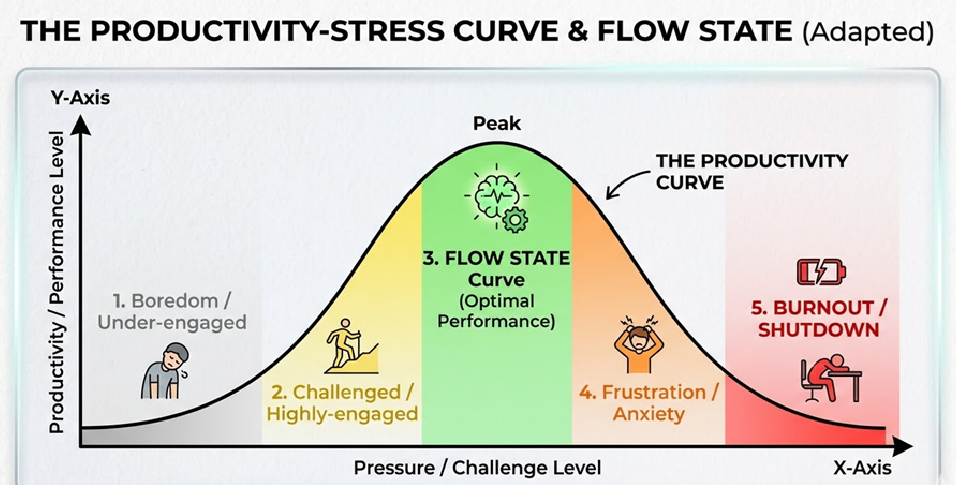
The ultimate goal of regulating your nervous system isn’t just to avoid feeling miserable; it’s to reach “Flow State.” Flow is the psychological state where work feels effortless, time seems to disappear, and your skills are perfectly matched to the challenge at hand.
You cannot reach a state of flow if your nervous system is stuck in survival mode. When you are stressed, your “prefrontal cortex”—the part of the brain responsible for complex logic—actually slows down. By integrating micro-breaks and ensuring you have the right support for your workload, you create the safety required for your brain to enter flow. This is where your best work happens, and ironically, it is much less tiring than working while stressed.
Creating a “Nervous System Friendly” Workspace
Your environment dictates your internal state. If your desk is a mess and your lighting is harsh, your nervous system will stay on edge.
- Natural Light: Try to work near a window. Natural light helps regulate your circadian rhythm, which in turn regulates your cortisol levels.
- Peripheral Vision: Occasionally soften your gaze and try to “see” the whole room without moving your eyes. This “panoramic vision” is biologically linked to the parasympathetic nervous system.
- Analog Elements: Keep something tactile on your desk, like a smooth stone or a wooden fidget toy. Touching natural textures can provide a quick grounding effect during stressful meetings.
The 2026 Productivity Paradigm
In the current global landscape, the “hustle culture” of the past decade is being replaced by “sustainable performance.” We are realizing that the human brain is not designed to process 12 hours of digital information without a break. The most successful people in 2026 aren’t the ones working the longest hours; they are the ones who have mastered the art of the “reset.”
They understand that taking sixty seconds to breathe, move, or look away from the screen isn’t “wasting time.” It is the highest form of professional maintenance. Just as a professional athlete wouldn’t dream of skipping their recovery sessions, a professional knowledge worker cannot afford to skip their nervous system regulation.
Your 5-Step Daily Recovery Plan
To turn this science into a habit, follow this simple daily structure:
- The Morning Anchor: Before checking your phone, do 3 physiological sighs. Set the tone for your day.
- The Mid-Morning Micro: Every hour, stand up for 60 seconds. Stretch your arms overhead to open your ribcage and improve oxygen flow.
- The Screen-Free Lunch: Eat away from your desk. Giving your visual system a break from “near-work” is essential for ocular and mental health.
- The Afternoon Reset: At 3:00 PM, when the “slump” hits, use the 20-20-20 rule or a quick somatic neck release.
- The Shutdown Ritual: At the end of the day, do a “brain dump” of your tasks. This signals to your brain that it is safe to stop “scanning for problems” and finally enter a deep state of rest.
Final Thoughts: Choosing Health Over Burnout
Your career is a marathon, and your nervous system is the engine. If you redline the engine every day, it will eventually seize up. By respecting your biological need for micro-breaks and knowing when to utilize support systems for your workload, you aren’t just protecting your health—you are protecting your future. Take the micro-break. Breathe deeply. Your work will still be there in sixty seconds, but you will return to it as a better, sharper, and calmer version of yourself.
Frequently Asked Questions
What exactly is a micro-break?
A micro-break is a short, intentional pause lasting between 30 seconds and five minutes. Unlike a traditional lunch break, these moments are designed to briefly disconnect your brain from high-focus tasks to prevent cognitive overload and physical tension.
How often should I take a break to stay regulated?
Research suggests that taking a 30-to-60-second break every 20 to 40 minutes is ideal for maintaining focus. Shifting your gaze or standing up briefly helps reset your internal stress response before it builds into long-term fatigue.
Can a one-minute exercise really lower stress?
Yes. Techniques like the “physiological sigh” or brief sensory grounding can instantly signal your brain to lower your heart rate. These actions flip a biological switch from a high-alert state to a calm, restorative state in under 60 seconds.
What are the signs that my nervous system is overtaxed?
Common indicators include persistent “brain fog,” irritability, and a “tired but wired” feeling where you are exhausted but cannot relax. Physical cues like shallow breathing or a clenched jaw often signal that your body is stuck in a stress cycle.
About the Author
Min Seow is a dedicated educator and digital strategist who focuses on the intersection of student wellness and academic success. As a senior consultant for myassignmenthelp, Min develops evidence-based strategies to help learners navigate complex research challenges while maintaining a healthy, balanced lifestyle.